
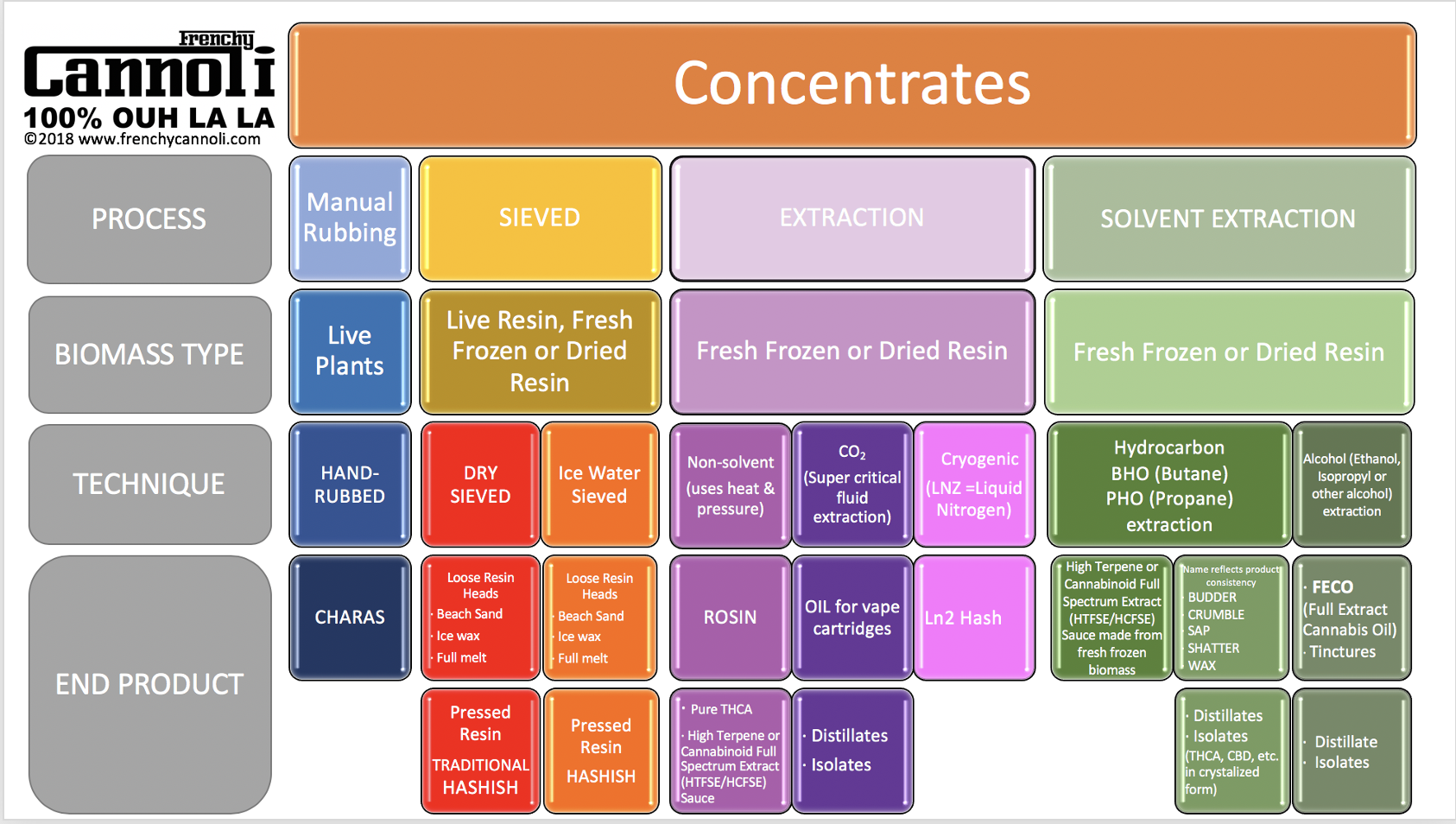
ALL CANNABIS RESIN PRODUCTS can be classified as "concentrates", from the sieved and unpressed trichome heads to the 99.9% pure isolates of THCA, CBDA, etc. known as "crystals". Once the resin has been separated from the plant matter using a sieving or an extraction process, the collected resin is a concentrate.
The methodology employed to collect the resin can be differentiated into three main categories: sieved resin, non-solvent extract, and an extract made with the use of a solvent.
SIEVED RESIN: Sieved resin is made up of loose trichomes heads collected whole. Dry sieving is the oldest form of collecting resin heads from dried and cured plants. The methodology is possibly as old as agriculture, 15,000 years old, and its origins unknown.
Ice Water Sieving: The use of water is the only evolution in the cannabis sieving process since its inception. The tools have improved dramatically while the methodology has not changed. It is still a simple sieving process however the use of water to rehydrate the plant matter which eliminates contamination, the main limitation to working with dry and brittle plant matter. The dry sieving methodology is made of two inseparable processes, the agitation of the plant material to detach the resin heads from their stalks and the separation of contaminants and resin heads through the perforations in the sieve.
The use of water changes the very foundation of the sieving methodology. The processes of agitating the plant material and separating the trichomes heads from their stalks can now be divided into two separate stages. The plant matter can be manually or mechanically agitated in ice cold water to detach the trichome heads optimally from their stalks, then the water holding the resin heads can be poured through the different sized sieving bags to maximize the separation process.
DRY SIEVE/ICE WATER SIEVE LIVE RESIN
A subcategory for dry or ice water sieved resin collected from live or fresh frozen material is also necessary. Live resin has a much higher terpene content, and a terpene profile that is as different to cured resin as hand-rolled live "Charas” resin from India is from traditional Lebanese or Afghan Hashish.
DRY SIEVE/ICE WATER SIEVE CURED RESIN
While cured resin may have lost a large percentage of its terpenes during drying and curing, approximately 80%, the polymerization process creates a new terpene profile that will be different from the live expression of the plant. Live and cured resin are two pinnacles of different expressions of the psychoactive and medicinal potential of the Cannabis plant; the terpenes are crucial to the overall quality of the resin, but the percentage of terpenes is not the only determining factor. The uniqueness and appeal of the terpene profile is an attribute that defines quality as well.
We do not have a universally agreed upon name for loose dry sieved or ice-water sieved resin heads. In fact, we have too many names. In producing countries and Europe, this product is called "pollen", which is confusing since biologically trichome heads have nothing to do with the plant's fertilization process. In the U.S., loose resin heads are called many things - kief, ice wax, beach sand, grease, full melt, bubble hash, water hash, granular hash, and the list continues. The different appearance of the sieved resin influences the descriptive name of the end product.
Hashish: Sieved resin pressed into a mass with a source of heat. Hashish is simply the unique and final expression of the wholeness of the cannabis plant's secondary metabolites. Hashish is the substance of legends, the source of numerous myths from diverse cultures born from thousands of years of secrecy; its origins and most of its history are unknown. The word Hashish should not be used for any other type of concentrate if not only for respect for history and traditions then for the simple fact that there is no other form of concentrate like hashish.
Extract: Pure resin extracted from the trichome heads of the Cannabis plant with the use of a solvent or a solventless process. A Cannabis extract is like the juice extracted from a fruit, a true expression of the fruit but not the same as the full fruit in all its nourishing wholeness and beneficial characteristics.
The fruit is the matrix that creates the juice as is the Cannabis trichome heads that biosynthesizes unique psychoactive and medicinal compounds; rejecting the matrix in a quest for purity is like extracting grape juice to make alcohol instead of crushing and fermenting the grapes to produce wine. This is the fundamental difference between sieved resin heads and all types of extracted resin, and while the manufacturing of hashish uses heat and pressure, the resin's head's cellular matrix is part of the final product and for this reason cannot be considered an extraction in the same manner that wine is not considered an alcohol extracted from grapes.
I need to give a little history here to put the rebirth of sieved resin in the U.S. into context.
Americans have been smoking cannabis flower since the '60s, and while hashish was not unknown it was nonetheless not common, and it became rarer with the U.S. government's crackdown on international smuggling in the mid-70s. North Americans primarily smoked cannabis flower until the rise and explosion of the solvent extract market that started approximately seven, ten years ago spearheaded by butane extraction. Solvent extracts in many forms have been the hottest items since. Many of the enthusiasts for extracts made with solvents never had the opportunity to experience sieved resin or traditional hashish and had no interest in any form of resin but the purest extracts.
Ice water resin was introduced and marketed by trailblazers like Nikka T from Essential Extracts as solvent-less extracts that were close enough to the potency, purity, and appearance of extracts made with solvents to become competitive over time.
Rosin is another product that was born from Nikka T's non-solvent approach to extraction.
NON-SOLVENT EXTRACTS
Rosin: Resin extracted with the use of heat and pressure from live or cured material. Rosin has been very popular the past three years in the U.S., a safe and apparently simple processing method to extract resin from sieved trichomes heads or directly from the flowers.
Rosin was the first true non-solvent extract and while squishing trichomes heads or flowers seemed unsophisticated as an extraction process, the number of products produced using mechanical separation is becoming extensive as the following extracts exemplify.
Pure THCA Non-Solvent Eхtract: A mechanical separation of rosin into a pure THCA isolate Non-Solvent Sauce: A mechanical separation of rosin into terpenes and cannabinoids promoting the natural formation and growth of cannabinoids in their crystalline form.
Carbon Dioxide (CO2) Extract: Carbon Dioxide is considered a non-solvent however CO2 at certain temperatures and pressures acts like a solvent by dissolving non-polar material, the process is known as Supercritical Fluid Extraction (SCF) and is widely used in the food, cosmetic and pharmaceutical industries. CO2 extracts are mostly used in vaporizer pens, salves, infused edibles, and drinks. The oil can then be processed further and purified into Shatter, THCA crystals, and Sauce but it is costly, labor intensive and hard to scale.
Liquid Nitrogen (Cryogenic) Extract: Liquid Nitrogen, heat and pressure are combined to produce an extract known as Liquid Nitrogen Hash aka Ln2 Hash. The process is labor intensive and hard to scale.
SOLVENT EXTRACT: Butane aka BHO (Butane Honey Oil), PHO (Propane Honey Oil) These natural gases are the favored solvents to use in Cannabis resin extraction. The different consistency of the resin created gives their name to the vast array of extracts available in the U.S.; Wax, Shatter, Budder, Honeycomb, Honey oil, Nectar, Sauce (high terpene full-spectrum extraction), Crumble, Live Resin.
DISTILLATE & ISOLATE: A distillate is the liquid form of a single cannabinoid. An isolate is the crystalline form of a single cannabinoid. Ethanol (Grain Alcohol), Isopropyl Alcohol aka RSO (Rick Simpson Oil): Ethanol not only captures cannabinoids and terpenes but water-soluble compounds as well.
Full Extract Cannabis Oil extracted with ethanol contain a wide range of plant compounds with a higher medicinal potential. Ethanol oil requires further processing to create extracts like Shatter, Wax, Budder, etc. Isopropyl alcohol contains more toxic substances than pure Ethanol and is a poor second choice to Ethanol.
The diversity of cannabis concentrates while expansive is certainly comprehensible when first defined by the methodology and medium used in the processing of the plant material. An agreed classification that would differentiate sieved resin, non-solvent extract, and extract made with the use of a solvent is mandatory to the evolution of the cannabis concentrate industry as a whole and should be legitimate in all legal states. I do understand and appreciate the need to simplify the bountiful diversity of the cannabis plant and its derivatives to a new and expanding market but is defining sieved resin heads as an extract a simplification or misinformation?
Frenchy Cannoli, Cannabis Concentrates Descriptions, creating a common classification, Skunk, Vol. 12, Issue 7, June 2019, pg. 36-38.